
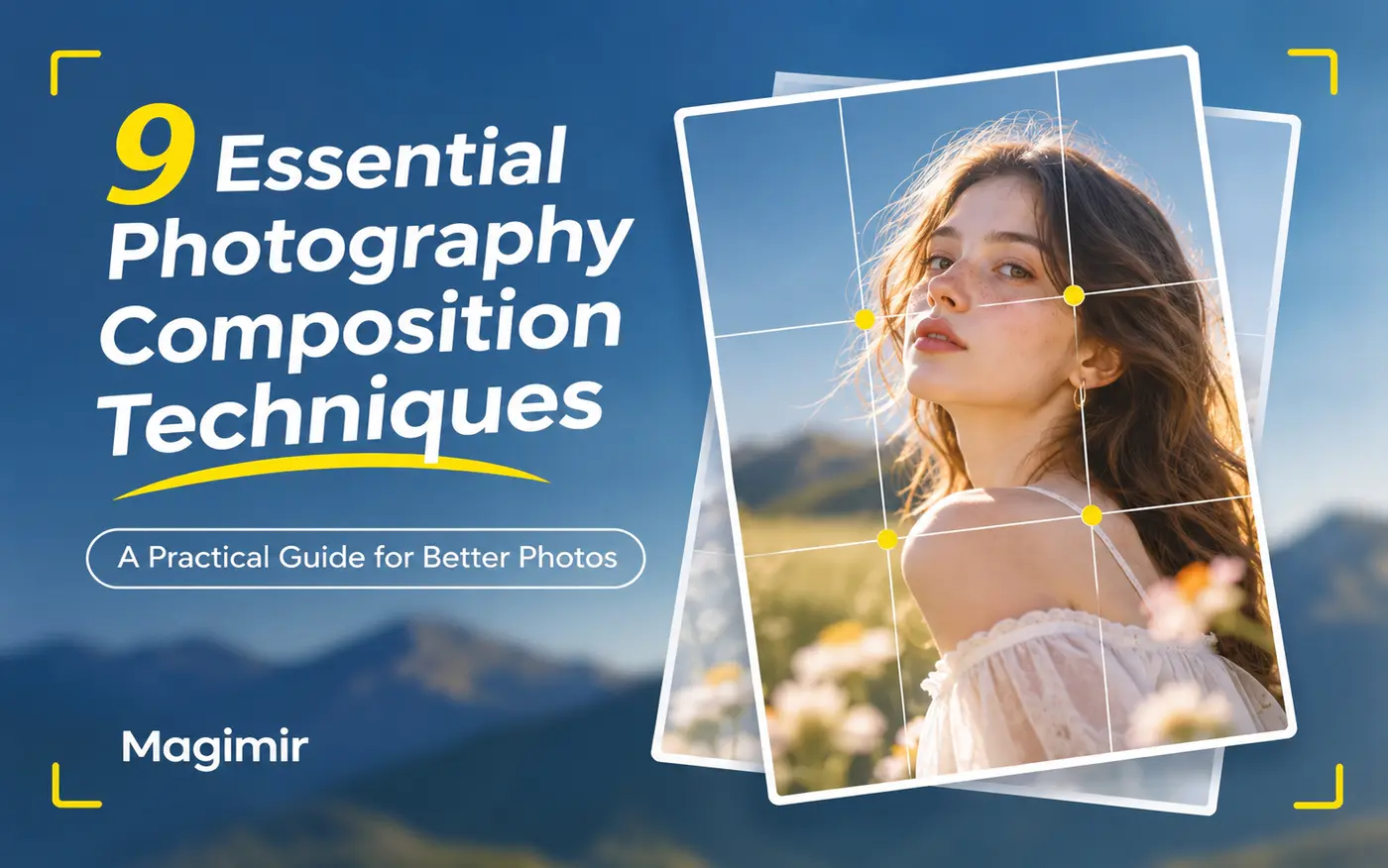
Learn nine simple photography composition techniques to create more balanced, engaging, and professional-looking photos.
Have you ever taken a photo with beautiful lighting and a great subject, but still felt something was missing?
Sometimes, the problem isn't your camera or editing skills. It's the composition.
Photography composition determines how elements are arranged within a frame. It helps guide the viewer's attention, create depth, and tell a stronger visual story.
Here are nine essential composition techniques every photographer should know.
1. Centered Composition
Centered composition places the main subject in the middle of the frame, creating a clear, balanced, and focused image.
This technique works particularly well for portraits, architecture, and minimalist photography.
Best for: Portraits, symmetrical scenes, and clean backgrounds.
Tip: Keep the background simple so the centered subject remains the main focus.
2. Rule of Thirds
The rule of thirds divides an image into nine equal sections using two horizontal and two vertical lines.
Instead of always placing your subject in the center, position it along one of these lines or near their intersections.
This creates a more dynamic and visually balanced composition.
Best for: Portraits, landscapes, travel photography, and street photography.
Tip: Try placing your subject's eyes near an upper intersection point.
3. Diagonal Composition
Diagonal composition uses diagonal lines to create movement, energy, and depth within an image.
These lines can come from architecture, landscapes, body posture, or objects in the scene.
Compared with horizontal and vertical compositions, diagonal arrangements often feel more dynamic.
Best for: Fashion photography, creative portraits, architecture, and action shots.
Tip: Look for natural diagonal lines or use your subject's body position to create them.
4. Framing Composition
Framing composition uses surrounding elements, such as doorways, windows, arches, or trees, to create a natural frame around your subject.
This technique draws attention toward the main subject while adding depth and visual layers.
Best for: Portraits, travel photography, architecture, and environmental photography.
Tip: Position your subject inside a doorway, window, or arch to create a stronger focal point.
5. Symmetry Composition
Symmetry composition creates visual balance through mirrored or evenly arranged elements.
Buildings, bridges, reflections, and architectural structures are excellent subjects for symmetrical photography.
Symmetry often makes an image feel stable, harmonious, and visually satisfying.
Best for: Architecture, reflections, landscapes, and minimalist photography.
Tip: Pay attention to the center line. Small alignment adjustments can make a big difference.
6. Triangle Composition
Triangle composition arranges the subject or key visual elements into a triangular shape.
In portrait photography, triangles can be created naturally through body posture, arms, legs, or clothing.
This technique creates stability, structure, and a strong visual focus.
Best for: Fashion photography, seated portraits, group photos, and creative compositions.
Tip: Use the subject's arms, legs, or body angles to form a natural triangle without making the pose look forced.
7. Negative Space Composition
Negative space composition intentionally leaves empty areas around the main subject.
Instead of filling the entire frame, it uses open space to emphasize the subject and create a sense of simplicity, atmosphere, or scale.
A small person beneath a vast sky is a classic example.
Best for: Minimalist portraits, landscapes, travel photography, and storytelling images.
Tip: Don't be afraid to make your subject smaller in the frame. Empty space can make the image more expressive.
8. Leading Lines Composition
Leading lines composition uses roads, corridors, buildings, railings, or other directional elements to guide the viewer's eye toward the main subject.
These lines create depth and help establish a natural visual path through the image.
Best for: Architecture, street photography, travel photography, and environmental portraits.
Tip: Look for lines that naturally converge toward your subject or a point of interest.
9. Foreground Composition
Foreground composition uses objects close to the camera to add depth and layers to an image.
Leaves, flowers, branches, and other environmental elements can create a soft foreground while keeping the main subject in focus.
This technique is especially effective in outdoor portrait photography.
Best for: Portraits, wedding photography, nature photography, and lifestyle shoots.
Tip: Shoot through leaves or flowers with a wide aperture to create a soft, blurred foreground.
How to Choose the Right Composition
Different photography scenes benefit from different techniques.
Photography SceneRecommended CompositionPortrait photographyCentered, Rule of Thirds, ForegroundWedding photographyFraming, Triangle, ForegroundLandscape photographyRule of Thirds, Negative Space, Leading LinesArchitecture photographySymmetry, Framing, Leading LinesFashion photographyDiagonal, Triangle, Negative SpaceTravel photographyFraming, Leading Lines, Rule of Thirds
You don't need to use only one technique at a time.
For example, a portrait can combine the rule of thirds with foreground elements, while an architectural photograph can use symmetry and leading lines together.
The key is understanding how each technique changes the viewer's experience.
Great Composition Starts Before Editing
Good photography begins with how you see and arrange the scene.
Composition helps you capture a stronger image in-camera, while post-processing can refine lighting, color, and overall presentation.
With MagiMir, photographers can further enhance their images using AI-powered portrait retouching, color adjustments, AI Lighting, and other creative editing tools.
But remember: editing works best when the original photograph already has a clear visual direction.
Master these nine composition techniques, experiment with different perspectives, and discover new ways to tell stories through your photos.