
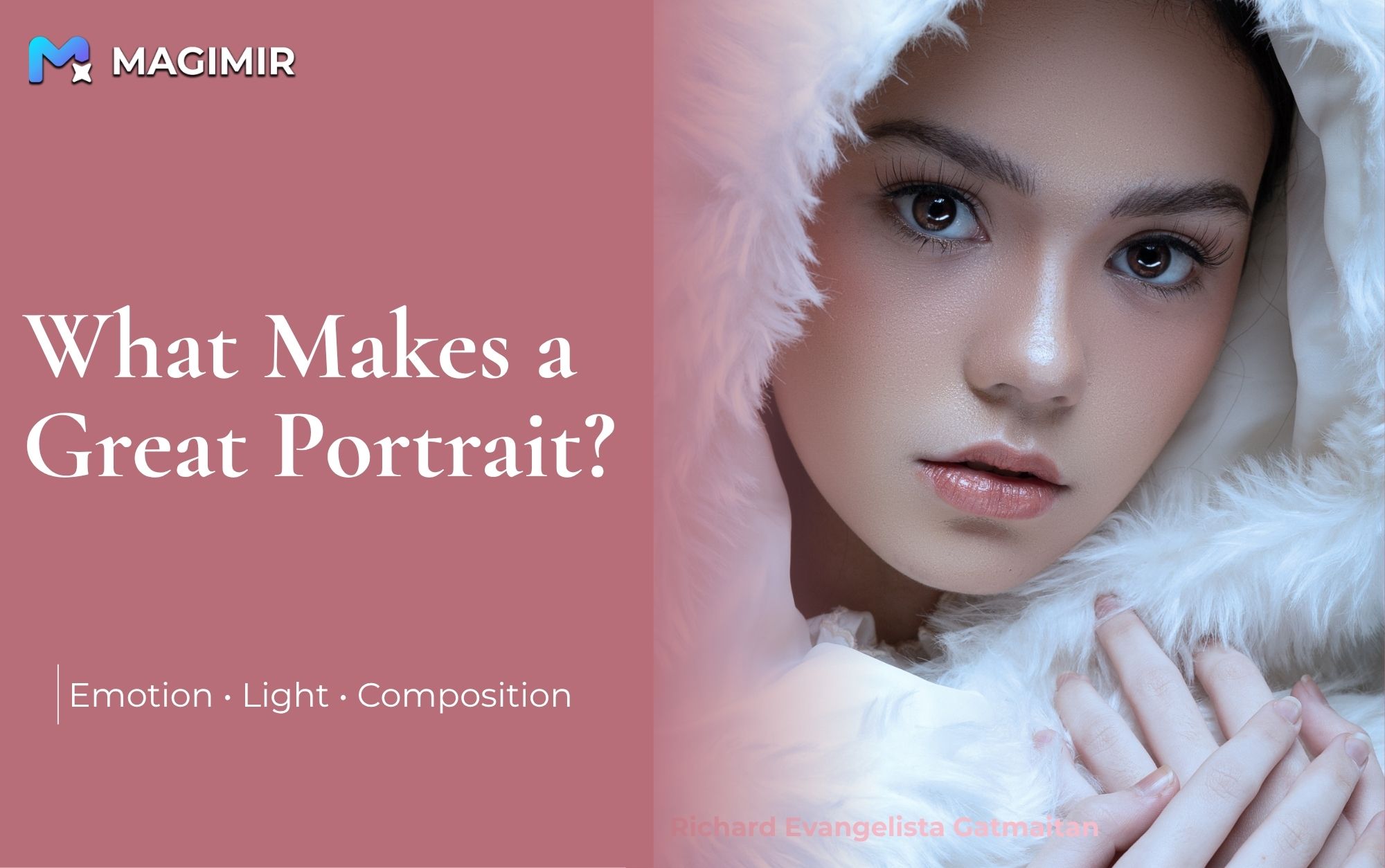
What Makes a Good Portrait Photo?
We can start with a simple question:
What makes a person look good?
Some people say it’s about perfect facial features. Others say it’s about a clean, natural presence.
But in reality, the kind of beauty we remember is rarely about perfection.
It’s about something more subtle:
- A sense of ease
- A genuine expression
- A feeling that this person is fully present
There’s life in the eyes. There’s emotion beneath the surface.
And when we move from real life into portrait photography, everything changes.
A portrait is no longer just about capturing appearance. It becomes a collaboration between:
- The subject
- The photographer
- The viewer
A truly good portrait exists in the space between all three.
1. A Good Portrait Goes Beyond Appearance
If a photo only records what someone looks like, it’s documentation — not a portrait.
Strong portrait photography captures presence, not just features.
It holds:
- A fleeting expression
- A moment of hesitation
- A quiet emotion that wasn’t spoken
These are the details that make an image feel alive.
When viewers look at a powerful portrait, they don’t just see a face. They begin to wonder:
- What is this person thinking?
- What just happened before this moment?
- Who are they, beyond this image?
A portrait with narrative depth is one people return to again and again.
Display image courtesy of the photographer-FB: Mark Philip S. Dales
2. A Great Portrait Reflects the Photographer’s Vision
A strong portrait is never created by the subject alone.
It is shaped by the photographer’s ability to see beyond the surface.
Great photographers don’t rely on rigid instructions like:
- “Turn your head”
- “Smile here”
Instead, they create space.
They observe, guide gently, and wait for real moments to appear.
They notice:
- The way someone’s expression softens in silence
- Small gestures in the hands
- Subtle changes in posture
This is not direction — it’s connection.
The result is a portrait that feels personal, not staged.
3. Light, Composition, and Color Create Structure
Emotion gives a portrait its soul. But visual language gives it structure.
Light Shapes the Face
Different lighting creates different emotional tones:
Soft light → calm, natural, intimate
Side light → depth and dimension
Backlight → softness and atmosphere
Good lighting often reduces the need for heavy retouching.
Composition Guides the Eye
Strong composition is about balance and intention.
- Avoid cutting joints awkwardly
- Use negative space wisely
- Let the viewer’s eye move naturally
The goal is simple:
👉 Make the subject the emotional center of the image
Color Defines Mood
Color grading is not decoration — it’s storytelling.
Low saturation → quiet, nostalgic
Warm tones → intimacy and warmth
Cool tones → distance and calm
Consistent color is what transforms a collection of images into a cohesive visual story.
4. Natural Retouching Preserves Life
One of the most overlooked aspects of portrait photography is editing.
Over-retouching can remove what makes a person feel real.
Great portrait retouching should:
Preserve skin texture
Avoid artificial smoothing
Maintain natural light and shadow
Keep subtle imperfections
Modern workflows focus on enhancing reality, not replacing it.
Tools like Magimir, for example, are designed to support this approach — helping photographers maintain natural skin tones and consistent color grading across entire photo sets without losing authenticity.
Because in the end:
👉 Real always feels better than perfect.
Display image courtesy of the photographer-FB: Richard Evangelista Gatmaitan
5. The Best Portraits Have a Sense of Life
This is the hardest thing to define — but the easiest to feel.
A truly good portrait has “breathing space.”
It doesn’t feel forced. It doesn’t feel over-edited. It doesn’t feel staged.
Instead, it feels like something is happening.
You can almost imagine:
A slight movement
The subject blinking
A quiet shift in emotion
There may be imperfections. But there is presence.
And presence is what makes an image unforgettable.
What Makes a Portrait Truly Beautiful?
A meaningful portrait is created when:
A photographer knows how to see
A subject shows their real self
Editing enhances rather than hides
It becomes a shared moment of:
👉 Seeing and being seen
Not just a photo — but a conversation.
Final Thoughts
In 2026, portrait photography is no longer just about technical perfection.
It’s about balance:
Light and shadow
Emotion and structure
Reality and refinement
When these elements come together, a portrait becomes something more than an image.
It becomes something people feel.