
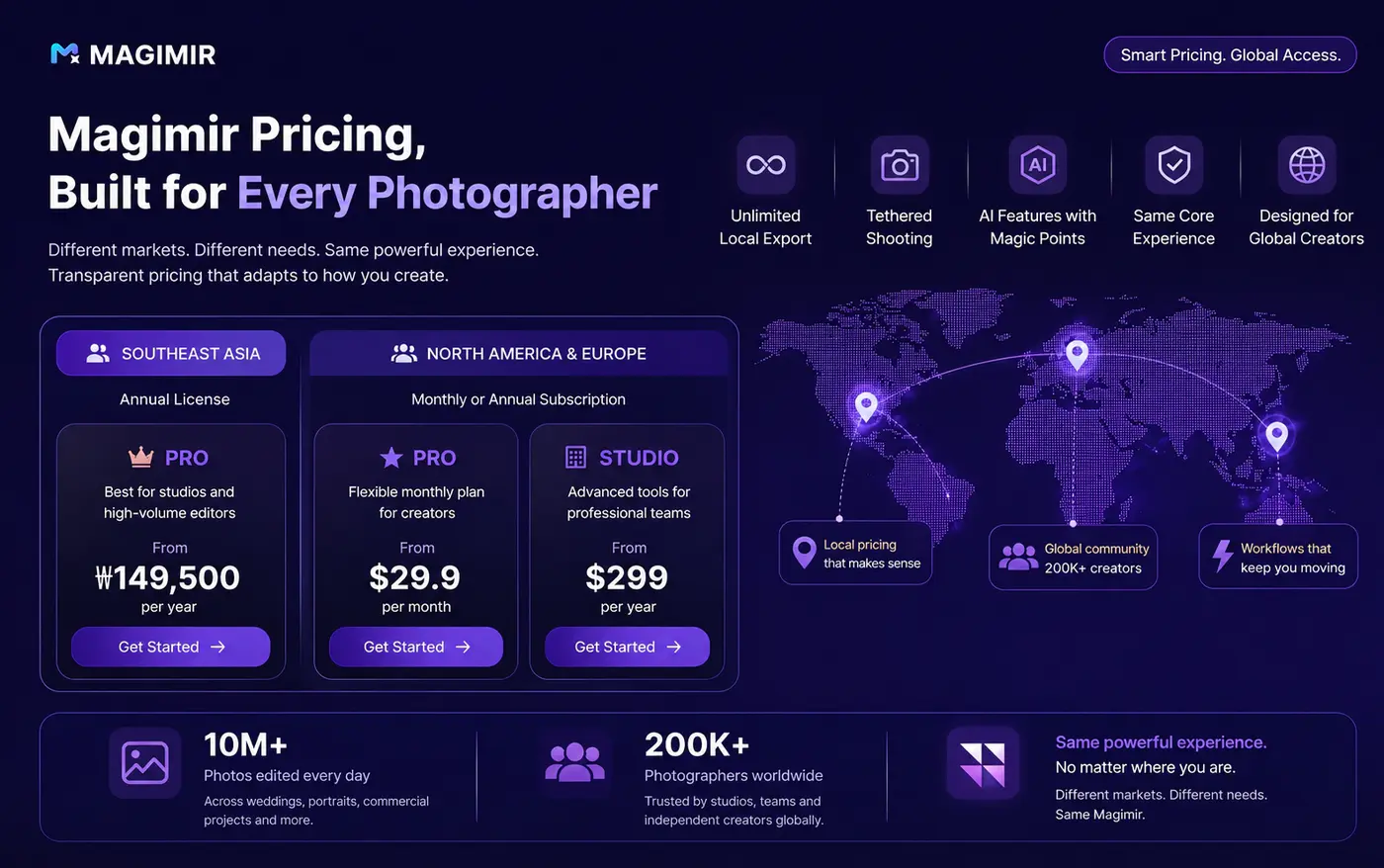
Why Magimir Pricing Works Differently Across Regions
One thing we wanted to make clear very early with Magimir:
Most core editing features support unlimited local export.
That includes:
- portrait retouching
- skin refinement
- body shaping
- professional color grading
- batch editing
- tethered shooting
- RAW processing workflows
For many photographers, especially studio teams, tethered shooting has quietly become one of the most important parts of the workflow. Shooting directly into the editing environment, checking color instantly, and keeping sessions visually consistent saves an enormous amount of time later in post-production.
But some AI features work differently.
Advanced passerby removal, object cleanup, and certain AI-powered erase tools use Magic Points because they rely on cloud computing rather than local device processing.
We felt it was important to separate those two systems clearly instead of hiding everything behind vague “usage limits.”
Local editing remains unlimited. Cloud-heavy AI processing uses cloud resources.
Simple.
Because honestly, most photographers are not frustrated by pricing itself.
They’re frustrated by uncertainty.
The Photography Industry Doesn’t Work the Same Everywhere
I used to think software pricing should be universal.
One product. One plan. One price worldwide.
But the longer we worked with photographers and retouchers across different countries, the more obvious something became:
Photography businesses operate very differently depending on the market.
Some photographers handle high-volume wedding batches every week. Some run portrait studios full-time. Others freelance seasonally or work project-to-project.
Even the way people prefer paying for software changes from market to market.
That’s part of why Magimir pricing structures may look slightly different depending on region.
Not because the software changes.
But because creative industries don’t function identically everywhere.
Different Markets Prefer Different Purchasing Styles
One thing we noticed early:
Not every photography market likes subscriptions in the same way.
In some regions, photographers strongly prefer stable long-term licensing. Especially studios handling weddings, graduation shoots, school portraits, or large batch workflows every day.
Predictable yearly cost matters more there than monthly flexibility.
In other markets, photographers are already very used to subscription-based creative software like Photoshop, Lightroom, or Capture One. Monthly subscriptions feel normal and integrate naturally into existing workflows.
Neither system is “better.”
They simply reflect different working habits and business cultures.
So instead of forcing one global pricing structure onto every market, Magimir tries to adapt more naturally to local creative workflows and payment expectations.
The Editing Experience Stays the Same
This part matters a lot.
Regardless of region, the core Magimir workflow stays consistent:
- unlimited local exports
- portrait retouching
- AI color workflows
- batch editing
- tethered shooting
- professional skin retouching
- background cleanup
- RAW editing support
The pricing structure may vary slightly depending on local purchasing habits and payment systems.
But the editing experience itself does not.
We never wanted photographers to feel like some countries receive a “limited” version of the software.
That completely goes against the idea of workflow consistency.
Why Unlimited Export Matters So Much
A lot of photographers quietly become stressed by editing software once every action starts feeling tied to usage calculations.
How many credits are left. How many exports remain. Whether testing another version costs more.
At some point, editing stops feeling creative and starts feeling transactional.
Wedding photographers usually understand this immediately because large projects involve huge numbers of exports, revisions, and client variations.
That hesitation before exporting sounds small, but over time it breaks creative momentum surprisingly fast.
One thing Magimir focuses on heavily is keeping the core editing workflow predictable:
Edit locally. Export freely. Keep moving.
Especially for high-volume portrait workflows.
Why Some AI Features Use Magic Points
This is where transparency matters.
Most editing tools inside Magimir work locally and support unlimited exports.
But some advanced AI functions require cloud-side processing power, which is why Magic Points exist for features like:
- advanced object removal
- passerby cleanup
- complex AI erase workflows
We felt separating local workflows from cloud-resource workflows was more transparent than blending everything together under hidden limitations.
Once photographers understand which tools are local and which tools rely on server-side AI, the pricing structure usually makes much more sense.
More Photographers Are Editing at Scale Than Ever
One thing that surprised us recently was how quickly high-volume editing became normal — not just for large studios, but for smaller teams too.
Today, photographers and retouchers process more than 10 million photos per day inside Magimir.
And the platform is now used by more than 200,000 creators worldwide.
That growth reinforced something important:
Most photographers are not looking for “magic buttons.”
They’re looking for stable workflows.
Fast previews. Consistent batch edits. Natural-looking skin. Reliable exports. Tools that don’t interrupt momentum halfway through a project.
As workloads grow larger, those details matter more and more.
Good Pricing Should Eventually Fade Into the Background
Honestly, the best pricing system is probably the one photographers stop thinking about after a while.
Not because it’s cheap.
Because it feels predictable enough that they can focus on shooting, editing, delivering, and moving on with work.
That’s ultimately the direction Magimir has been trying to move toward:
Not pricing designed around pressure.
But pricing designed around workflow continuity.Start your free trial now